Steak Night Redefined – Easy Ribeye with Chimichurri Sauce You’ll Crave Again 2025
There’s something undeniably satisfying about a perfectly cooked steak: a rich, juicy interior, a deeply caramelised crust, the steak’s natural flavour shining through. And when you pair that with a bright, herbaceous sauce like chimichurri, you elevate the whole meal into something memorable.
This article will guide you through every step—from choosing the right cut of beef, understanding the science of searing, to crafting a fresh chimichurri sauce and serving ideas that impress. Whether it’s for a date night, weekend treat, or simply because you deserve it—read on for the complete guide to seared ribeye steak with chimichurri.
Why You’ll Love This Dish
- Restaurant-quality at home: With the right technique and ingredients, you can achieve a steak-house level dish in your own kitchen.
- Minimal yet powerful ingredients: The focus stays on quality—good beef, fresh herbs, bold flavours.
- Quick and versatile: Although it looks ‘special occasion’, it can be ready in under an hour from start to finish.
- Naturally diet-friendly: Gluten-free, and very adaptable to low-carb or keto-style meals.
- Stand-out flavour profile: The richness of the ribeye meets the bright, tangy herby punch of chimichurri—it’s a perfect marriage of textures and tastes.
Choosing the Right Beef: Ribeye and Beyond
Why ribeye?
Ribeye is a fantastic choice because of its marbling—the thin veins of fat throughout the muscle. When properly seared, that fat renders and adds both flavour and succulence. A good ribeye remains juicy, bold, and doesn’t dry out quickly under high heat.
Thickness matters
For best results, aim for steaks that are about 1.5 inches (≈ 3.8 cm) thick. This gives you enough “meat” to develop a crust while keeping the interior tender and juicy.
Alternative cuts
While ribeye is ideal, you can also consider cuts like:
- NY Strip (striploin) – slightly leaner but still great flavour.
- Skirt or flank steak – thinner, more fibrous, but still very worthy when sliced correctly. Some recipes use these cuts with chimichurri. RecipeTin Eats+2The Modern Proper+2
- If you go thinner, reduce cooking time and beware of overcooking.
Buying tips
- Look for beef with good marbling—white flecks of fat inside the muscle.
- Choose steaks that are uniform in thickness for even cooking.
- If you can, ask your butcher for a dry-aged or well-matured piece for extra flavour.
The Science of Searing and Resting
Why bring the steak to room temperature?
Allowing your steak to sit out of the fridge for 30–45 minutes before cooking helps it cook more evenly. A cold core can cause the exterior to overcook before the interior reaches your desired doneness.
Pat dry for better crust
Moisture is the enemy of crisp crusts. Use paper towels to thoroughly dry both sides of the steak before seasoning. The dryer the surface, the better the Maillard reaction (the browning) will occur.
Pre-heat your skillet
A heavy cast-iron skillet is preferred because it retains heat well and gives that ideal sear. Heat it for 3–5 minutes on high until very hot, add a small amount of olive oil, then place the steak.
Searing the steak
- High heat is key for the crust.
- Let the steak cook undisturbed for ~3-4 minutes per side for a 1.5″ steak depending on doneness (see next section).
- Use a meat thermometer for accuracy.
Internal temperatures (before resting)
- Rare: ~120-125 °F (~49-52 °C)
- Medium-rare: ~130-135 °F (~54-57 °C)
- Medium: ~140-145 °F (~60-63 °C)
- Medium-well: ~150-155 °F (~66-68 °C)
Bear in mind the temperature will rise a little during resting.
Resting is vital
Once off the heat, transfer your steak to a cutting board, loosely tent with foil, and let it rest for at least 5–10 minutes. Resting allows the juices to redistribute; slicing too early often means losing precious juices and ending up with drier steak.
Slicing against the grain
Especially for cuts like flank or skirt, identifying and slicing against the grain (i.e., across the muscle fibers) ensures each bite is tender rather than chewy. RecipeTin Eats+1
Crafting the Chimichurri Sauce
What is chimichurri?
Chimichurri is a vibrant herb-based sauce from Argentina and Uruguay, traditionally served with grilled meats. It typically features parsley, garlic, olive oil, vinegar, oregano and chilli flakes. Wikipedia+1
Why it pairs so well
- The acidity (from vinegar) cuts through the richness of beef.
- The fresh herbs add brightness and lift.
- Garlic and chilli give bold flavour to complement (rather than compete with) the steak.
Ingredients (for about ½ cup/120 ml)
- 1 cup (loosely packed) fresh flat-leaf parsley, finely chopped
- 3 cloves garlic, minced
- 2 tbsp fresh oregano (or 1 tbsp dried)
- ½ cup extra-virgin olive oil
- 2 tbsp red wine vinegar
- ½ tsp red pepper flakes (adjust to taste)
- ½ tsp salt
- ¼ tsp freshly ground black pepper
Method
- Combine parsley, garlic, oregano in a medium bowl.
- Add olive oil, red wine vinegar, red pepper flakes, salt, and pepper.
- Stir well to combine. Let the sauce sit at room temperature while you cook the steak—or better yet, make it 1-2 hours ahead to let flavours meld.
- Store extra sauce in a sealed jar in the fridge for up to a week.
Tips & variations
- For extra brightness, add a splash of lemon juice.
- For a spicier version, increase chilli flakes or add a pinch of cayenne.
- Swap in fresh basil or cilantro for part of the parsley for a flavour twist.
- If you’ve got time, marinate the steak in a few tablespoons of chimichurri for 30–60 minutes before cooking (especially if using a leaner cut).
Step-by-Step: Seared Ribeye with Chimichurri Sauce
Step 1: Prep the steak
- Remove ribeye from the fridge 30–45 minutes before cooking to reach near room temperature.
- Pat thoroughly dry with paper towels.
- Season generously on both sides with salt and freshly cracked black pepper, pressing the seasoning into the surface.
Step 2: Heat the skillet
Place a cast-iron skillet over high heat. Allow ~3-5 minutes until very hot. Add ~2 tbsp olive oil and swirl to coat.
Step 3: Sear the steak
Place the steak in the skillet carefully (it will sizzle). Let it sear undisturbed for ~3-4 minutes. Flip and cook the other side for ~3-4 minutes more (adjust based on thickness and your desired doneness). Use a meat thermometer for accuracy.
Step 4: Rest the steak
Transfer to a cutting board, loosely tent with foil, and let rest for 5–10 minutes. This step is non-negotiable for juicy results.
Step 5: Slice and serve
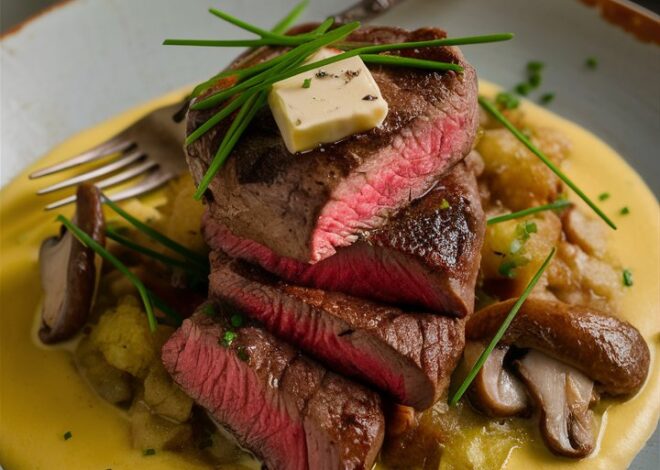
Slice the steak against the grain into ~¼-inch (~6 mm) strips. Arrange on a serving plate, spoon generous amounts of chimichurri sauce over the top, and serve extra sauce on the side for dipping.
What to Serve With It
This dish is rich and flavourful, so pairing with the right sides helps balance the meal.
Side options
- Roasted or smashed potatoes with garlic and herbs.
- Grilled vegetables: zucchini, bell peppers, asparagus.
- Creamy mashed cauliflower for a low-carb option.
- Crisp green salad with a light vinaigrette.
- Crusty bread to soak up the remaining sauce.
Drinks
The bold beef and tangy sauce call for a robust drink. Try a full-bodied red: Malbec, Cabernet Sauvignon or Syrah all pair beautifully.
Variations & Substitutions
Swap the cut
- Flank or skirt steak: less marbling, faster cook time, slice thinly.
- Sirloin: leaner but still good.
- For extra indulgence, try a bone-in ribeye or tomahawk.
Marinated version
Mix 3-4 tbsp of chimichurri with the steak in a sealable bag. Refrigerate for 1 hour. Then sear as above. The marinade adds extra flavour and helps tenderise leaner cuts.
Herb or flavour tweaks
- Use cilantro instead of part of the parsley for a fresher twist.
- Add lemon zest for a citrus edge.
- For a smoky depth, incorporate smoked paprika into the sauce.
Cooking method variation
- Grill: Preheat grill to high. Sear steaks for 3-4 minutes per side (or until the internal temps above). Works beautifully outdoors.
- Broiler/oven finish: Sear in skillet, then finish in a preheated oven at 400 °F (≈ 200 °C) for a few minutes if the steak is very thick.
Storage, Leftovers & Reheating
Steak
- Store leftover sliced steak in an airtight container in the fridge for up to 3 days.
- Reheat gently: use a skillet over medium-low heat for a minute or two per side, or microwave at 50 % power in short bursts to avoid drying out.
Chimichurri sauce
- Store in a sealed jar in the fridge for up to 1 week. Bring to room temperature before serving.
- The flavours continue to develop after sitting, so if you make it ahead, you’ll get deeper flavour.
- Can also freeze in ice-cube trays; thaw a cube for a quick burst of flavour any time (though texture may change slightly for the best presentation).
Frequently Asked Questions (FAQs)
Can I use a different sauce instead of chimichurri?
Yes—but part of the appeal of this dish is the bright contrast between rich steak and fresh sauce. If you switch, choose something equally bold (e.g., garlic-herb butter, peppercorn sauce, or salsa verde).
Do I have to use olive oil for the searing?
Olive oil is fine and lends good flavour, but ensure it has a high smoke point (extra-virgin is okay so long as you watch it). Alternatively, you can use a neutral high-smoke-point oil (such as grapeseed or avocado oil) and finish with a drizzle of olive oil if desired.
How do I know when the steak is done?
A reliable meat thermometer is your best friend. Insert into the thickest part of the steak: target temps (before resting) are around 120-125 °F for rare, 130-135 °F for medium-rare, 140-145 °F for medium.
Can I make the chimichurri ahead of time?
Absolutely—and it’s better if you do. The flavours meld over time. Make it 1-2 hours ahead (or even the day before) and keep refrigerated. Just bring it to room temp before serving.
What if my steak is thinner or thicker than 1.5″?
- Thinner (<1″): Reduce searing time accordingly—maybe 2-3 minutes per side. Be careful not to overcook.
- Thicker (>2″): After searing, you might need to finish cooking in the oven so the centre doesn’t remain too rare.
Common Mistakes & How to Avoid Them
- Not drying the steak: If the surface is wet, you’ll get steaming rather than searing—less crust.
- Cooking straight from fridge: Cold centre means uneven cooking. Let it rest out for 30–45 minutes.
- Under-seasoning: A well-seasoned steak makes all the difference. Use enough salt and pepper.
- Skipping resting: If you slice too soon, juices will run out and you’ll end up with a dryer steak.
- Using low heat for sear: You want that instant stop of arching browning—high heat is key.
- Cutting against the grain incorrectly: This leads to tougher bites. Always check fibre direction.
- Serving sauce cold from fridge: Room temperature or slightly cool sauce works best for flavour.
Nutritional Snapshot (Approximate per Serving)
Here’s a rough estimate for one seared 10 oz ribeye steak + chimichurri sauce:
- Calories: ~650-750 kcal
- Protein: ~50-60 g
- Fat: ~45-55 g (depending on steak cut & trimming)
- Carbohydrates: very low (< 5 g)
- Suitable for low-carb/keto with appropriate sides.
Final Thoughts
Steak night doesn’t have to mean complicated, time-consuming preparations or expensive dining out. With the right technique and fresh ingredients, you can create a dish that hits all the marks: flavour, texture, presentation, and satisfaction.
The rich, juicy ribeye paired with the bright, tangy chimichurri is a combination that works on every level. Write it into your rotation, whether for a special evening or simply because you want something outstanding at home.
Try it once—and you’re very likely to never go back to plain, un-enhanced steak again.
Happy cooking, and enjoy every mouthful!